Let’s say they were American Woodcocks, so charmingly known
as Timberdoodles, although they may have been Ruffed Grouse. The American Woodcock attracts comment and is
also called a night partridge, big-eye, bogsucker, and mudbat. I caught a
glimpse—almost too generous a word given the brief time I saw them—of three
that fed on the forest floor as they rapidly fluttered to camouflage themselves
in the duff and shrubs that edged the trail. The Woodcock is a shorebird in the
sandpiper family that forages in young forests and shrubby places, digging for
worms with its long, slender beak, which ends in a flexible tip. As soon as I
saw this passage about their hunting behavior, I knew I had to quote it, “A
woodcock may rock its body back and forth without moving its head as it slowly
walks around, stepping heavily with its front foot. This action may make worms
move around in the soil, increasing their detectablity.” At first I read this
as delectability, which I find a little more amusing, but I’m still left
thinking that they are clever as well as pretty darn cute.
Wednesday, August 28, 2013

Wednesday, August 21, 2013
Porcini (Boletus edulis)

Three friends, two dogs, and I went mushroom hunting in the
mountains of northern Colorado. We were a merry group, our good cheer
heightened by the pounds and pounds of porcini we found in the conifer forests.
They seem to like to grow along trails. I asked my friend Donna why they grow
where they grow, and she said, because they are “gregarious.” If that
explanation doesn’t satisfy, then it should be known that this mushroom grows
in late summer and early autumn, in sunny yet forested areas, commonly on
north-facing slopes, during years of good rainfall. They often appear along
with the Amanita muscaria, a mushroom
that looks as though—with its white-dotted, brilliant red cap—it should star in
a fairy tale or, even better, a Technicolor Disney movie, something Bambi would
see in the forest during the idyllic portion of his life. But, with toxic
qualities, its really more like something a evil witch would give children
wondering through the forest, or the hallucinogenic mushroom Alice nibbled on.
Don’t eat it. Porcini, on the other hand, are a “choice edible,” meaning they taste
delicious. When I got home, I spent hours cutting them up before leaving them
out in the sun to dry. Taking care of them was some work, as I had to bring
them in at night, so they wouldn’t get dewy, set them out every morning, and then
package them in half gallon size jars that I’ve temporarily stolen from the
dairyman from whom we get our raw milk. Now these delicacies from a boon year will
enrich winter dishes like soups and risottos and act as reminders of summertime,
and of my friends Alison and Jerry, who are moving to Seattle next month.
Wednesday, August 14, 2013
Common Loon (Gavia immer)
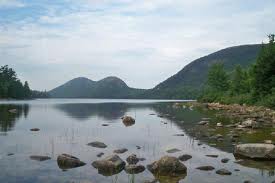
I was totally thrilled to see a Common Loon while walking
around Jordan Pond in Maine’s Acadia National Park. I would have cavalierly passed
by if not for a family who pointed it out to my husband and I. The family had
been photographing the loon for three hours, trying to capture an elusive image.
The above image is one of Jordan Pond. Although I didn’t hear its eerie call, I
was excited enough just to see it in summer plumage, with its dramatic white
and black checked back, sailing upright and magnificent. I’ve always wanted to
see a Common Loon, and had no idea I would see it on a “pond” (what we in Colorado would
call a lake) in Maine. Common Loons are made for diving in pursuit of fish.
Adaptations such as setback legs and—unusual among birds—heavy, solid bones,
allow them to do things like flip-flop underwater and make them excellent at
what they do. But these same traits make flight, or at least take off,
challenging. Loons can get landlocked if they don’t
find the thirty yards or up to a quarter of a mile they need to build up speed.
Unfortunately, patches of dark, wet pavement and small ponds can act as traps,
deceiving the birds into believing they’ve found sufficiently large bodies of water.
The Common Loon is no sluggard when aloft, though, and has been clocked
migrating at up to 70 m.p.h. The loon made me think a lot about the mechanics
of flying on our flight home—how much propulsion a plane has to have to lift
all of that weight into the air and especially about landing—how the plane has
to slow, yet maintain a certain speed so it won’t fall out of the air. (For a
technical description of the four elements of flight, see this site.)
My favorite fact about the loon, though, is that two adults and their two
offspring can eat up to half-ton of fish in fifteen weeks.
Wednesday, August 7, 2013
Indian Pipe (Monotropa uniflora)

The enigmatic poet Emily Dickinson described the Indian Pipe
as the “preferred flower of life,” but it’s commonly known as the corpse or ghost
plant. I’m not good at conundrums and wonder what she meant. Reputed to be
Dickinson’s favorite flower, I’ve seen references to at least three of her
poems that mention the Indian Pipe. Native Americans used Indian Pipe, later
called eyebright, to treat eye inflammation. Colonists knew the flower as
convulsion root, because they used it to treat convulsions. Nowadays, medicinal
plant experts warn that it may be toxic. The plant exists widely, except for in
the southwest, the intermountain west, and the central Rockies. I was lucky
enough to see it while hiking in a dense, “humusy” Maine forest. The Indian
Pipe is a saprophyte, an organism that feeds on dead or decaying matter. More accurately,
the plants are parasites that feed on fungi that in turn feed on trees. These wildflowers
don’t need leaves to produce chlorophyll, so the plants do not have any green,
and the leaves are merely scales or bracts. The plants turn black with age or
when damaged—these were new and pristine, white with a pinkish tinge, waxy,
with drooping heads.
Wednesday, July 3, 2013
Wednesday, June 26, 2013
Foxglove: Digitalis purpurea

From the first time I saw one, the complex coloration and
bell-shaped flowers of the foxglove attracted me, and I knew I wanted some in
my garden. They are one of the first plants I planted last year, and this June they
are blooming extravagantly. They are happy where I’ve planted them, growing in
partial shade. A local nursery explained that foxglove is a biennial that acts
like a perennial, flowering in its second year and then self-sowing.
Fortunately, the plant produces up to two million seeds during its lifetime. I
have a cream one and a mauve one, and I didn’t know that the cream will revert
to purple during the reseeding cycle. The heart medication digitalis is made from
its leaves, and you can murder someone with an overdose, in the best tradition
of Agatha Christie’s stories. The plant is also poisonous to animals, but I
didn’t know that bees love it, along with other insects, and hummingbirds. The
flower’s inside is florescent, and this florescence, which can be seen under a
black light, guides bees like a “landing strip.” Fairies figure prominently in
legends surrounding the foxglove, no surprise given its magical appearance and
native woodland habitat. A Modern Floral says that people once believed the dappling on the flower were fingerprints
left by fairies, leading to the name folksglove. My favorite story is that bad
fairies gave the blossoms to foxes to muffle their footsteps as they hunted.
Thursday, June 20, 2013
Elaeagnus angustifolia: The Case For, The Case Against

Until this year, I had not noticed the honeysuckle-like fragrance
of the Russian olive trees (Elaeagnus angustifolia).
And, with their gray-green leaves, they provide a pleasing contrast to the
darker leaves of the cottonwoods that also line the rivers. I have a friend
who, not without reason, claims that they provide food for animals and fix
nitrogen in the soil.
But, the smell of the flowers becomes cloying, the fruits
are unpalatable to the human tongue (or at least they were to me when I tasted
them), and, most importantly, in Colorado where I live, the tree is a non-native
invasive species that rapidly crowds out native species. A report by Columbia
University claims that in Colorado, Russian olive trees have replaced hundreds
of thousands of acres of willow and cottonwood woodlands.
The state categorizes the Russian olive as a noxious weed slated for eradication,
containment, or suppression.
But, what about my friend’s claims? Although it’s true they
provide food for birds, this is the case only for some species, and trees
appear to reduce “avifaunal diversity.” Cavity-nesting birds and woodpeckers, for example, do not use the Russian olive
tree, and so its spread destroys the richness or variety of birds present in a
location.
What about its nitrogen-fixing abilities? According to
various Web sites, this quality interferes with “nutrient cycling” by
attracting other species that prefer high nitrogen soils and outcompete native
species that survive on less fixed nitrogen.
Finally, Russian olive trees are almost impossible to
control. They do not attract insects, grow from suckers (making pruning ineffective),
and resist fire. They thrive on a variety of water, temperature, and soil
conditions.
My friend’s knowledge is true as far as it goes, but taken
within the context of the riparian areas of the western United States the case
against the Russian olive tree is watertight.
Subscribe to:
Posts (Atom)